All posts by Mary Ann

Passionate and personable instructional designer with 6 years of experience in online course development (via D2L Brightspace, Blackboard, Engage, Canvas, and Wordpress) and 14 years of experience in training/development and providing instructional support for university faculty.

Presentations and Facilitation

I’ve developed and taught numerous workshops. Some of these include basic computer skills for adults, information literacy and study skills for undergraduate students, and crafting learning objectives and backwards design for college professors. I’ve also mentored faculty on the instructional design process and using technology effectively in their courses. The video below is a workshop I facilitated at the University of Kentucky on integrating social media in the classroom:


Here are some presentation materials that I developed and then presented for our Faculty Fellows program at the University of Kentucky. This program helped faculty across the university to develop and assess assignments designed to improve students’ multimodal communication skills.

Infographics and Job Aids


As the Instructional Technology Manager, I developed the technical infrastructure for the Presentation U! Center, including methods for tracking center usage and providing online tutoring. You can view this job aid I created on using Zoom to conduct remote tutoring sessions.


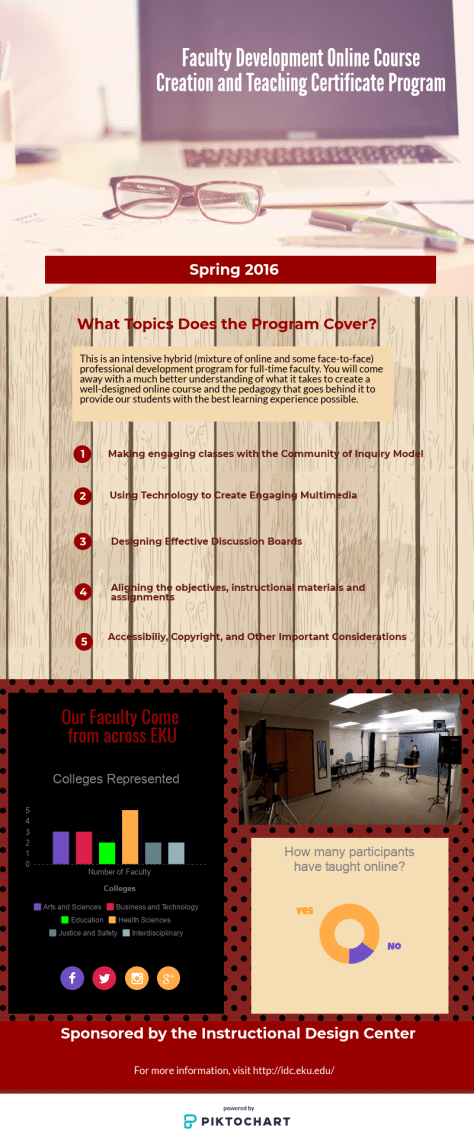
At Eastern Kentucky University, I helped facilitated our faculty professional development program. Here’s an infographic that I synced with Google sheets in order to capture real time data from participants.

faculty-pd-spri_11750341


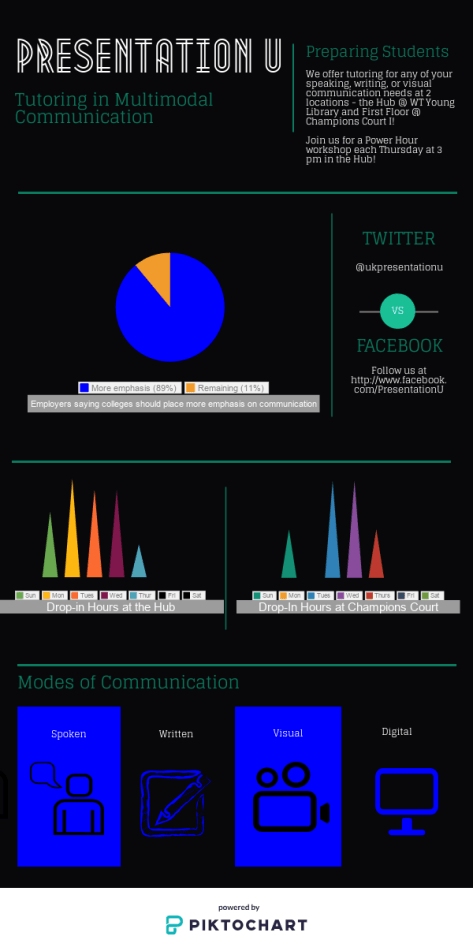
Here’s another infographic I created as a basic information sheet for the Presentation U! Center. The Presentation U! Center offered tutoring in speaking, writing, and visual communication for all students at the University of Kentucky.

center-operatio_2825051

Interactive eLearning

Here is an interactive grammar tutorial I developed for a special education course at Eastern Kentucky University. I made this tutorial in iSpring. I also have experience creating interactions in Captivate, Articulate Storyline, and H5P.

Note: The content was provided by and belongs to Dr. Michelle Gremp. Please contact Dr. Gremp (michelle.gremp @ eku.edu) before sharing or republishing this tutorial.

Why Turtle Learning Designs?

Well, turtles are amazing. I happen to love turtles, but beyond my personal preferences, I think that turtles can provide a powerful analogy for intentional and effective teaching. Just as turtles can easily hide inside their shells, we can’t really know what is happening in the black box of the brain unless students come out of their shells and demonstrate their learning in some way. That means we need to get students moving with the content. I’m committed to creating education that is active and evidence-based. Whether online or face-to-face, students should apply what they are learning in authentic scenarios, and we need to measure what is happening in courses in order to evaluate and refine them. Turtles may not seem to do much, but there’s more going on than we think, and changes in their regular behavior are important indicators of what is happening in their environment. Some would argue that learning can be defined as changes in behavior. Educational contexts may vary in the amount of student output they produce which can be observed and measured, but we can’t claim students are learning unless we find a way to pre-assess learning outcomes and systematically observe and measure the changes that occur as a result of the learning experience.

Turtles are also mobile, carrying their homes with them. In the modern age of ultra-connectivity, students are coming to us from a wide range of settings and locations. That means our education has to be self-contained and portable, able to flourish in a variety of contexts. The structure of a turtle is a fairly simple design, but they withstand the test of time, living much longer than humans in many cases. The best courses are not filled with the latest trends in technology or flashy gimmicks. Instead, they are built on solid principles of learning and utilize the most appropriate technology to accomplish their objectives. They are designed with accessibility in mind from the beginning, and are therefore flexible enough to accommodate students’ needs across time, distance, and device.

Finally, turtles are fun. I’ve not yet met somebody who didn’t like turtles (and I hope I never do!). In order to be truly effective, well-designed teaching has to engage students. It has to connect with their emotions, interests, and goals. I am a firm believer that learning is most powerful when it is fun, and I’m always looking for ways to make content relevant and exciting for students.

So in a nutshell, why Designer Turtle? Because I’m an instructional designer who is committed to creating courses that are sleek, solid, mobile, accessible, evidence-based, and playful. Like turtles, turtle courses withstand the test of time. Check out my portfolio to see some samples of my work. If you would like those kinds of courses in your organization, give me a shout.
Activity 4.3 Learning Styles

I’ve heard various learning style theories advocated in public schools, teacher preparation programs, and college classrooms.  Pasher et al. (2009) make a compelling case that while learning preferences may exist, research has not supported the advantage of using different instructional strategies for these preferences.  Reading their article highlighted two key distinctions for me.  First, learning preferences should not be confused with learning aptitudes. The kind of information people prefer to receive is not necessarily the kind of information they remember most readily.  Pasher et al. demonstrated that there may be some need to vary the instructional context based on aptitude, although the studies they examined had mixed results.  In some cases, student achievement correlated with both aptitude and the amount of structure provided in the lesson, but in other cases, high aptitude students consistently outperformed low aptitude students regardless of the amount of structure.  At any rate, if a learning styles theory does exist, it appears that it would be more fruitful to target student abilities rather than student preferences.  Most commercial tests measure how students perceive they learn, and don’t systematically analyze how the students actually process information.  These tests may indeed be worthless.  There could be a place for tests targeting specific aptitudes, but more research needs to be conducted in this area as well.  Secondly, learning styles theories seem implicitly based on an either/or construct.  According to these theories, a person who is more verbal will learn more information if it is presented verbally rather than visually.  In reality, sensory registers work together to help people learn.  Even if someone is strongest in verbal ability, that person may also have well-developed visual ability.  Strength in one area does not necessitate weakness in another area.  As the lecture by Dr. Willingham pointed out, some kinds of information can only be appropriately presented in one modality.  Furthermore, students may benefit from receiving some kinds of information in mixed modalities.  Too narrow a focus on targeting information to a student’s highest ability could reduce overall learning by limiting the parts of the brain that can be employed to help that student process the information.  Much of the research indicates that an effective pedagogy can benefit most students, regardless of learning style.  There is room, though, for more research in this field.

Activity 4.2 Short Memory Test

Going through these exercises really helped me reflect on the strategies I use to remember information.  I definitely experienced the dual channels for auditory/phonetic and visual/spatial that Baddeley described on the long list number recall because I recited some of the numbers in a repeating loop while holding a picture of some of the other numbers in my mind.  I could not have pictured all of the numbers nor could I have repeated all of the numbers but I could hold both processes in my mind at once to remember a greater percentage of the numbers.  Also, just as Baddeley asserted, meaning associations were the most powerful memory aids for me.  On Item 14, most of the names I remembered were family members’ names.  In fact, this association was so strong in my mind that I erroneously substituted by brother’s name, Jason, for Jay.  When I first started the paired word recall, I can remember thinking to myself, “How in the world am I going to remember this?”  Then I started creating connections between the words.  I pictured actions in my head.  I did much better on that exercise than I expected.  I actually performed worse on the paired words involving imagery because I found the pictures distracting from my own connections.  Interestingly, Vince Kellen wrote a dissertation on how students with poor spatial skills can actually be hindered in learning by complex images.  I did feel more stressed during that exercise as I simultaneously worked to interpret both the words and the pictures.  This creates a caveat to the comments I made in my last blog post, where I discussed the importance of appealing to multiple modalities.  It raises the question of how a teacher can predict when involving multiple senses will aid learning and will it distract.  For me the images distracted by forcing associations other than the ones I was ready to make.

Activity 4.1 Resource on Perception

Pinker’s description of the accommodations that the brain makes in order to accurately perceive reality–such as the way the brain makes vertical objects look longer than horizontal objects to compensate for the natural foreshortening of 3D objects directed away from us in our vision (see Pinker, 2002, p. 200)—made a big impression on me.  I wondered if these accommodations are present at birth or develop through our interactions with the world.  As a result, I began searching visual perception in infants.  As an aside to the main thrust of this post, I did find a fascinating article on how infants respond to pointing movements that I think gives some evidence that the human tendency to follow a moving hand is innate rather than learned (see Click here for article in EBSCOhost).

In the course of my search, however, I stumbled on a TED Talk with a different focus, how complex hearing is and how that corresponds to our appreciation of music.  In this video, Charles Limb talks about the limitations of cochlear implants and the multitude of factors that go into deriving beauty from songs.

TED Talk by Charles Limb

Limb starts his presentation with an interesting assertion, that our senses do more than help us survive in the world.  They also make it possible for us to find beauty in our experiences.  Limb contrasts language, which is goal-driven, with music that is more experientially based.  Learning to interpret music is different than learning to interpret words.  As a result, patients with cochlear implants have a much easier time understanding and appreciating language than they do music. 

For me, this TED Talk has major implications for education.  First, it demonstrates how humans use a complex variety of information sources to construct meaning.  All of our senses are intricate devices that have evolved to distinguish subtleties in the kind of information they receive.  Am I attuned to this idea as a teacher?  Am I teaching my students how to construct meaning in multiple modalities?  Do I make sure that the messages I send are consistent across sensory inputs, that I have coordinated what my students experience with all of their senses?  For example, students who do not have hearing difficulties will react to a film showing a woman walk down a dark alley differently based on the music in the background.  If the music has frightening tones, they will interpret the act as dangerous, but if the music has playful tones, they will probably find the clip more humorous and harmless. 

Secondly, a wide range of physical impairments can affect my students’ ability to construct meaning from their experiences.  In the PowerPoint on sensory registers, the second component of the information-processing model, we learned that “sensory limitation can result in information being distorted.”  Limb described all the things that happen inside the ear while people listen to music.  A malfunction in even one area changes the way music is received and the potential response of the individual.  As a result, senses do not involve a simple have or don’t have binary.   A student may not have an obvious hearing impairment, but may still “hear” music differently from me.  Before jumping to conclusions about a student’s meaning-making ability, I should consider that something could be happening in a student’s sensory register.  In addition to meeting students’ different learning preferences, creating lessons in multiple modalities can help balance potential differences in students’ sensory abilities.

Activity 3.4 Constructivism Applied to Bart Simpson

The school for geniuses that Bart attended had many of the elements of a constructivist environment outlined by Angela O’Donnell.  Students engaged in authentic problem-solving which they had a choice in selecting.  There was an emphasis on experiential learning, and students had access to a variety of real-world tools to assist them in completing their work.  The students learned in a variety of social contexts from dyads to whole class discussions.  Through the whole class discussions, they articulated their reasoning, building knowledge through the use of language.  On the other hand, one major element of dialectic constructivism missing was scaffolding.  Apart from the teacher’s questions in whole group discussion, problem-based learning appeared minimally guided, which made the class seem more attuned to endogenous constructivism.  Furthermore, the school assumed this environment was only appropriate for “geniuses,” while constructivist pedagogy assumes that all children learn in this manner.

Thank You Angela O’Donnell

I appreciated reading the article this week by Angela O’Donnell. It helped clear up some confusion I had regarding constructivism as an epistemology vs. pedagogy.  Last semester, I was told that it was logically inconsistent to teach in a constructivist manner if one held an objectivist epistemology.  To believe in an accurate knowledge external to the individual necessitated using direct instruction as a teaching strategy.  I don’t believe this way.  I believe that we construct our views of the world, but that these views can “correspond, more or less adequately, to reality,” to borrow the words of Piaget (as cited in our Module 3 PowerPoint).  Therefore, I think constructivist strategies are appropriate in the classroom.  Students must actively engage the environment in order to learn, even though I think that some forms of knowledge ultimately reside outside of the individual.  (I must qualify “some” because there are clearly some forms of knowledge which are socially constructed.  Unlike many social constructivists, though, I don’t believe that all knowledge is socially constructed.)  I appreciated O’Donnell’s explanation of Moshman’s three kinds of constructivism.  Moshman distinguished between exogeneous, endogenous, and dialectical constructivism.  Endogenous constructivism is the kind I encountered in my course last semester.  It is based on the idea that knowledge is internally developed and different from person to person.  In exogeneous constructivism, however, knowledge resides in the environment, but constructivist strategies are appropriate in helping learners to assimilate accurate mental models.  Dialectic constructivism is a blend of these two forms of constructivism.  I relate most to dialectic constructivism due to the distinction I made earlier between external and socially constructed knowledge.  I now understand much better from a theoretical perspective why I have been so drawn to Vygotsky, who I was previously led to believe resided in a much different intellectual camp from myself.  While I don’t think Vygotsky would have completely agreed with my epistemology, I can now see from O’Donnell’s explanation how Vygotsky’s perspective is more closely aligned with mine than many of the other education theorists.

O’Donnell, A. M. (2012). Constructivism. In K. R. Harris, S. Graham, & T. C. Urdan (Eds.) APA educational psychology handbook, Vol. 1: Theories, constructs, and critical issues (pp. 61-84). Washington, DC: American Psychological Association.